
We Read to Stay Human
Sometime before school began this year, between reading an article about living in a post-literate society, and another on AI companies buying rare books, to rip apart and feed into their almighty thinking machines, I decided my 9th graders would read The Odyssey.
I spent the summer immersed in my own personal curriculum: Joseph Campbell's lectures on archetypes; a two-week Van Gogh pilgrimage up the East Coast as a sidekick to my friend on her own quest; Christopher Nolan's The Odyssey, in IMAX. All set to the drumbeat of doom in my head. Literacy is dead. Attention spans shrinking. Tech stole our attention; now it wants our identity – our humanness, chopped and churned into a goop of uncanny nonsense that is always close…but not really.
It’s uncomfortable to admit, but the way Western literature began isn’t so different from the way AI works. The original stories were told, retold, recorded, translated and retold again. Generated by generations of human brains.
But oh, those brains, those beautiful human brains in human bodies, sharing those stories around communal fires, with love and passion, committed to conceiving and reconceiving these stories again and again because they were important. They were transcendental. Each retelling brought forth a new turn, another layer – each retelling sometimes a little less, and sometimes a little more, than the last. Homer is legion. We are Homer.
So why turn to this nearly 3000-year-old story, and why tell it to a bunch of ninth graders, fresh out of middle school? Concrete thinkers newly plunged into high school? Why tell this story of stories?
My reasoning was tribal in nature. It was my primitive shout to the universe, “What does it mean to be human now?”
And I came back to my truth. We read to stay human. Ninth graders read to know themselves. So we begin.
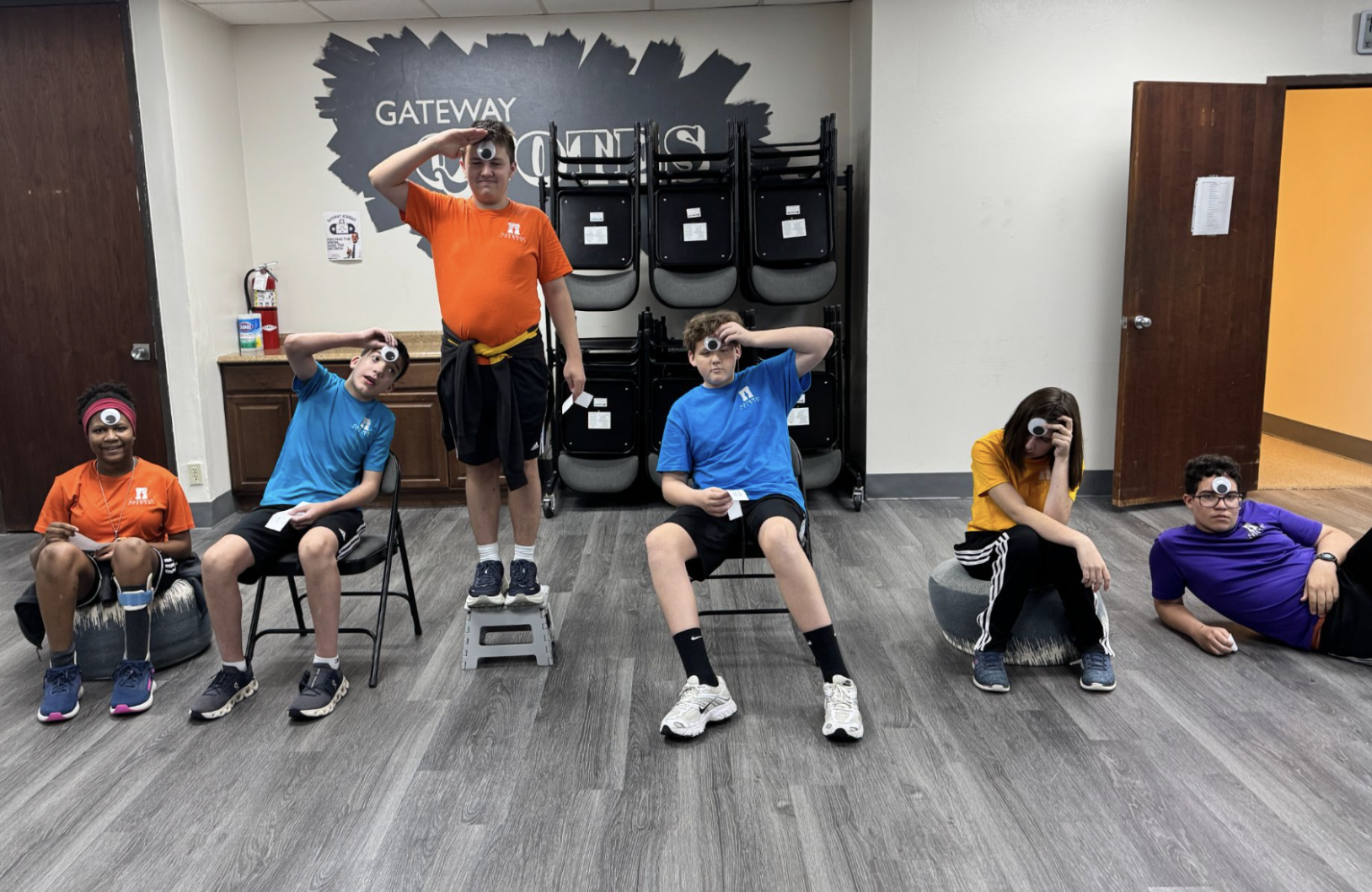
Students in Mrs. Heller’s class explored plot structure after reading about the Cyclops in The Odyssey, highlighting key events and how they move the story forward.
When Greece was young, theater and storytelling were part of the ancient rites. Priests were actors, and actors were masked and costumed. Theater was sacred. The poems were the liturgy.
Building a lesson is a bit like writing liturgy.
The routine of ritual is what every human craves, so I set up a series of lessons that have the same pattern. There’s a gathering moment, there’s the reading, there’s the contemplation and processing (written or discussed) at the end. In our class of students with learning differences, we use multiple modes to understand literature: we create art, we act, we watch, we listen, we discuss, we move our bodies. Every way we can embody this story, we will. Just as our ancestors would commune with these stories, so we will in our classroom. We have the opportunity to explore it all, every which way, and we do.
First, we view. I screen the 1997 miniseries starring Armand Assante. It's cheesy and a bit over the top, but I use clips to teach plot, setting and characters. For students on the spectrum, watching is a vehicle for learning. We watch, we review, we analyze: what is this character thinking? What are they feeling? What do you think will happen next?
I read aloud what we just watched, using an adapted text – not the poem, but a narrative version that is still stocked with the classical Homeric conventions. We are immediately thrown into the action, and we know the theme of the story right away: this is about a long-awaited homecoming of the ingenious hero Odysseus, favored by Athena, punished by Poseidon. Reading aloud is the norm in my class, keeping students engaged and aiding students struggling with dyslexia.
The poet begins with a plea to an unseen muse, “Give me the words I need to tell this story about this man.” What a prayer. If we could all start each utterance with such a prayer: please give me what I need to express my story, to tell it true. Muse, keep me mute until my thoughts are fully formed so I may claim the truth that is mine. Lesson: Make your story true.
We learn about the mess that is Odysseus's home. His wife and son are left alone for a decade, because Odysseus is sent off to war. And over one hundred suitors have squatted in the royal palace to pressure Queen Penelope to take a new husband. These men are really opportunists and bullies, demanding xenia, or reciprocal hospitality. The suitors demand much more than they give: they want constant service, attention, and to upset the domestic tranquility that the palace of Ithaca offers.
I start with xenia – the definition – and one student pipes up, “You mean, if a homeless guy shows up to my house, I have to let him in and feed him?” and a class discussion begins. I immediately know I’ve got them.
I explain the philosophy of xenia comes from the understanding that we are all one; ancient Greeks would treat one another well, because any person may be a god. We in the modern world may recognize xenia as the golden rule: do unto others as you would have them do unto you. The rule is echoed through many ages and many cultures. So, we give and we receive; we are obligated to give even if the other party does not reciprocate. We do it because it is the human thing to do. Lesson: We give anyway.
At this point of the story, Telemachus has to make a decision. With Athena’s urging, he is told to go to sea and search out news of his lost father. Telemachus is inexperienced and unskilled. He has never left Ithaca, much less captained a ship. This is what we will call a “threshold” moment. Telemachus is a boy who must choose to be a man, in spite of his youth and lack of knowledge. He must risk his life to save his mother and home.
The students spend a day drawing a ship that represents their strengths, with the ocean symbolizing what supports them. The sails are opportunities or challenges that move them forward, or that stall them when winds don’t blow their way. The sky is filled with clouds that show their dreams and wishes. When they have drawn these symbols, they write the words to explain what they know about themselves. Drawing and using graphic organizers helps students sort through and select thoughts worth writing about. Lesson: Know what carries you.
Now we shift our gaze and at last meet Odysseus. He is the classic Greek hero — flawed, impossible to define, and yet so very human. We brainstorm a list of character traits. He is impulsive and brave and, as one student states, “a bit of a jerk.” He has won the Trojan war, but is desperate to get home. We meet him at a very familiar place: that state of continual disappointment, when all you get is more lost rather than where you want to be.
We read the adventures of the Odyssey chronologically, for the sake of simplicity, so we first find Odysseus on the island of Polyphemus, the Cyclops. Odysseus and his men stumble into a dark cave on the island, only to be held captive by the giant, grotesque, one-eyed Polyphemus. Polyphemus brutally devours several of Odysseus’ men, and when all seems to be lost, our hero comes up with a daring plan to escape the cave and get back to the ship. The crew successfully get back out to sea, but not before Odysseus loudly declares that he wounded the Cyclops, who happens to be Poseidon’s son.
We watch the clip, then read from the graphic edition of the story by Gareth Hinds. Once we dissect the story, we get the story up on its feet. The students unscramble a summary of the story, and label each part of the plot structure. Then they arrange themselves in a row - on the floor, on chairs, standing tall on a stool – to represent the shape of the story. At the end of the lesson, everyone gets a giant googly eye to wear in the middle of their foreheads. They pose for a picture, like the ancient masked priest-actors: a chorus of Cyclops. Lesson: Story has shape.
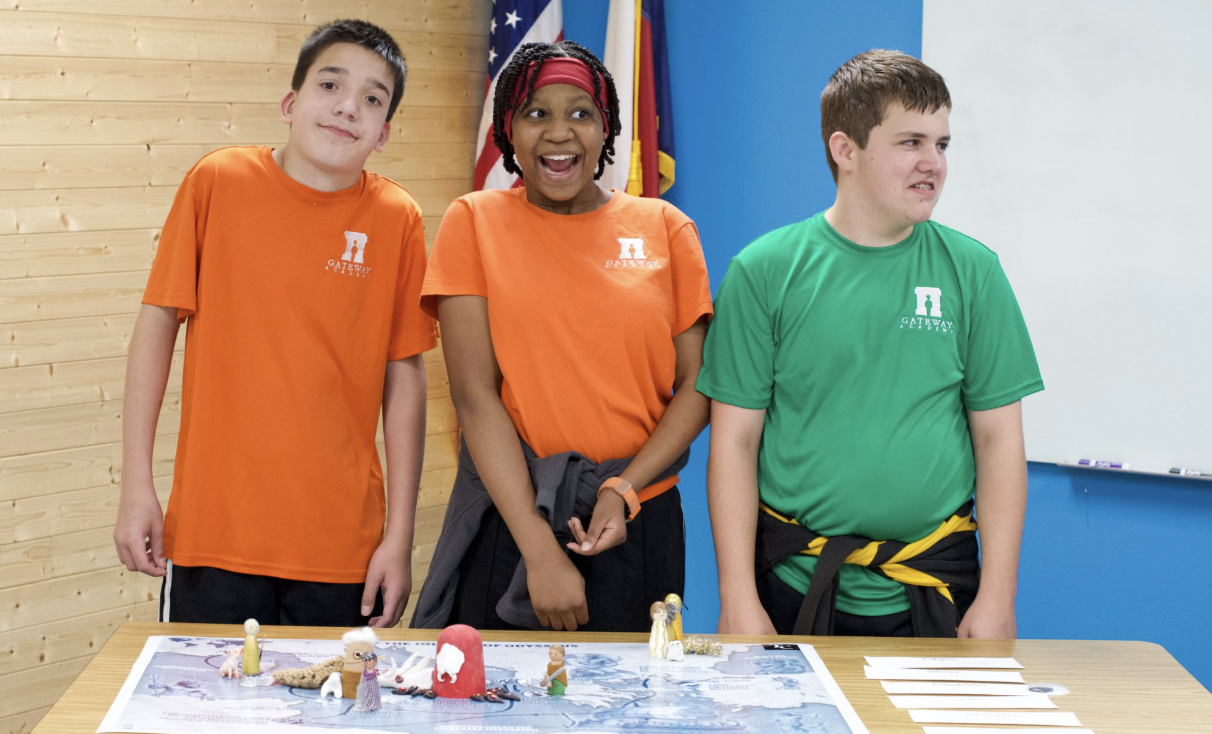
Students in Heller's class brought The Odyssey to life with a museum-style exhibit featuring figures from the epic. Faculty and fellow students explored the display, asked questions, and learned about each character's role in the story.
To add another visual dimension, I spread out a printed map of ancient Greece, with the lines of Odysseus’ journey winding through the Mediterranean. I pull out small wooden figures I painted myself, to look like the characters we’ve met so far. I tease the hands-on project we will end with, when everyone will have a chance to make their own version of an Odyssey character before the end of the unit. We still have witches and goddesses and monsters to meet.
I point to the next stop on the voyage: the home of the enchantress Circe, whose palace is surrounded by wild animals that are shockingly tame. Circe invites half the crew to feast with her, then proceeds to morph the men into pigs. Because she can. The always-lucky Odysseus is armed with a magical herb from Hermes (holy moly!), and thus resists Circe’s spell. He promptly refuses her hospitality; he will not accept her companionship until his men are restored. Lesson: Promises of friendship mean nothing without action.
Circe sends Odysseus off with warnings of the perils ahead. Our class sails past the lotus-eaters, the sirens and the underworld (these big stories are worthy of a unit of their own), and head straight for the monsters. The many-headed, many-toothed Scylla and the deadly whirlpool Charybdis are the hook for these students. Odysseus must pass between them to get home, and he chooses to lose six men to Scylla rather than his whole ship to Charybdis. Lesson: Sometimes the only way out is through, and it will most assuredly cost you something.
Eventually, Odysseus loses his boat and his men. He is alone, clinging to the mast of his busted ship, and he washes up on the shore of Calypso. Exiled for all eternity, this beautiful goddess takes him in, heals him, but refuses to let him leave. Odysseus sits on her shores, for seven years, gazing across the sea to his beloved Ithaca and Penelope, crying piteously. At last, the gods intervene. Calypso is ordered to release him. But she cannot; she loves him. She cajoles him with an offer of immortality if he would only stay and forget his former life.
Odysseus is at a threshold. Stay and live forever. Go and risk losing your life for the hope of returning home.
Thresholds are everywhere, so the class takes a walkabout in our school. We leave my classroom and stop at the head-of-school’s office. We talk about what it feels like to be called to this office. What we feel, what we imagine will happen, just before we enter the room. We may be in trouble, or we may not be. Will we be complimented or confronted with an issue?
We head toward the next stop: the lobby. What’s it like to step over the threshold into the lobby at the end of the day? What about to step out of the building to the carpool line?
We end with a pause at the teachers’ lounge – a forbidden zone. We go through the same questions: what does crossing this threshold do for you? How are you different? What does it cost?
We end up back at the classroom, stepping in from the hallway. The students finish writing about their walk and we close the lesson for the day. Lesson: Thresholds are opportunities that come with risks.
Odysseus is still on Calypso’s shore, deciding. My students are at their own threshold: the end of their first quarter of high school. Before they step through, they will do what the poets did before them. Search for the right words and tell their story true. So then we write.
Monica Heller, B.A. – High School Learning Specialist
Monica Heller brings a passion for literacy, communication, and student growth to Gateway Academy. As a parent of two children with learning differences, she understands the importance of helping students build confidence and independence. In her classroom, Monica combines practical literacy, critical thinking, and social-emotional learning to prepare students for life beyond Gateway. She holds a bachelor's degree in Drama and Speech, an ELAR 6–12 teaching certification, and previously taught job readiness skills to adults seeking employment.